

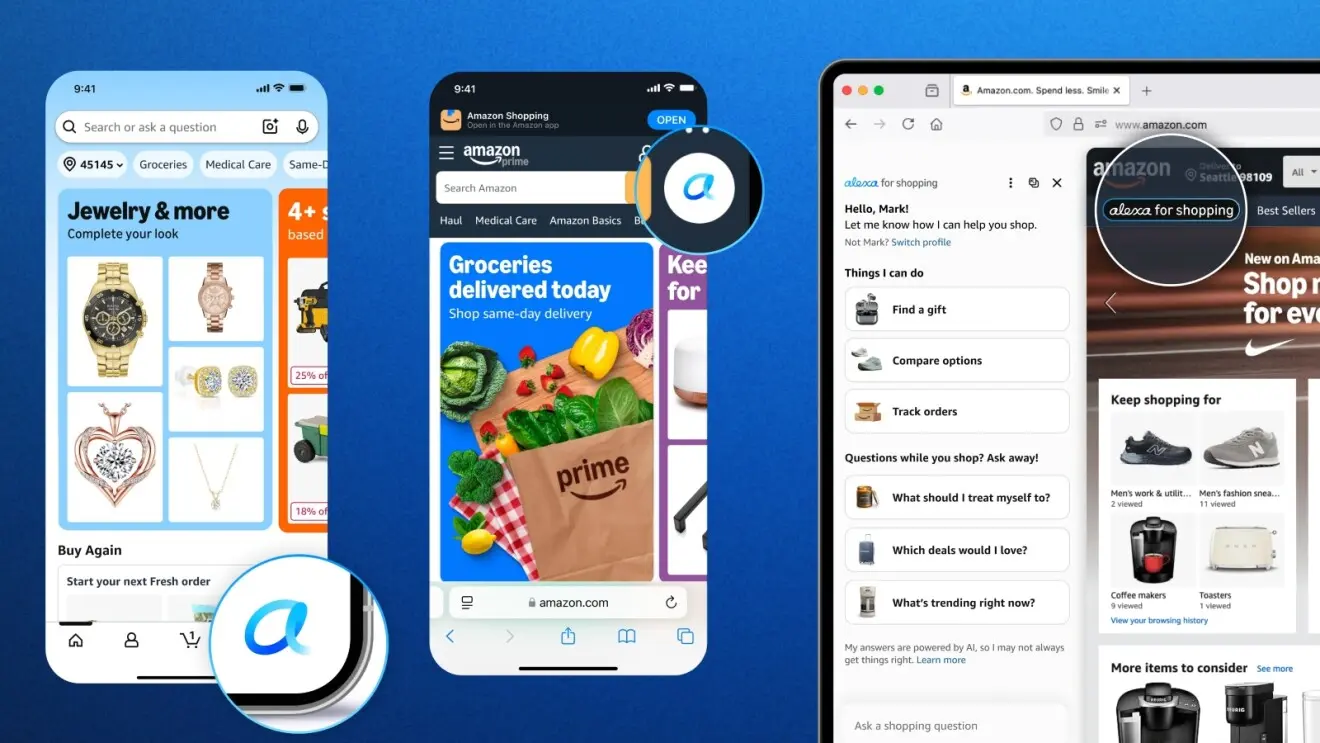
Quick answer: On 13 May 2026, Amazon retired the Rufus brand name and folded the technology into its new shopping agent, Alexa for Shopping. The recommendation logic, data sources and touchpoints did not change, only the name. What matters for sellers is that this AI layer now mediates roughly 15 to 20 percent of shopper queries on mobile, and it does not rank products the way A9 does. It reads your entire listing, including reviews, Q&A, A+ Content text and backend attributes, then decides whether your product genuinely fits what the shopper described.
Keyword density will not get you recommended. Completeness and clarity will.
If your listings were written for keyword search and have not been revisited since 2024, they are now competing in a game with different rules.
What actually changed, and what did not
There is a lot of noise about this. Here is the accurate version.
What changed: the branding. Rufus is gone as a consumer-facing name. The assistant is now Alexa for Shopping, sitting inside a wider Alexa ecosystem.
What did not change: the underlying technology, the data it draws on, or how it selects products to recommend.
What is changing fast: adoption. The assistant is handling an estimated 15 to 20 percent of mobile shopper queries, and that share is climbing each quarter. More significantly, the average query in an AI-mediated session is around 2.4 times longer than a traditional search query.
That last number is the one worth sitting with. A shopper no longer types “coffee grinder.” They type something closer to “quiet burr grinder for a small apartment kitchen that works with light roast beans.” Your listing either answers that or it does not.
Why keyword-only listings now underperform
Classic Amazon SEO optimized for A9, which matched search terms to indexed fields. Alexa for Shopping works differently. It synthesizes meaning across your full product record.
| Signal | A9 keyword search | Alexa for Shopping |
| Title and bullets | Primary | Read, but one input among several |
| Backend search terms | Primary | Contributes to context |
| Review content | Indirect, via conversion | Read directly |
| Customer Q&A | Not used for ranking | Read directly |
| A+ Content text | Not indexed historically | Read directly |
| Structured attributes | Filtering only | Used to verify fit |
| Ratings volume and quality | Ranking factor | Confidence signal |
| Use case clarity | Not measured | Central |
The practical consequence: a listing can rank on page one for its head keyword and still be passed over by the AI assistant, because nothing in the listing states who the product is for or what problem it solves.
Conversely, a listing with thorough attributes, specific use cases and strong review depth can be surfaced for long, descriptive queries it never explicitly targeted.
The nine fields most UAE sellers are leaving incomplete
In audits we run through our Amazon SEO service, the same gaps appear repeatedly. None of them are difficult. Most are simply unfinished.
- Structured attributes left blank. Material, dimensions, capacity, compatibility, age range, power source. These are the fields the assistant checks to confirm a product actually fits the described need.
- No stated use case. The listing describes what the product is, never who it is for or when they would use it.
- A+ Content that is image-only. Graphics with text baked into the JPG are invisible as text. Put the words in the text fields too.
- Q&A left unanswered. Every unanswered question is a gap in your product record and a signal of neglect.
- Negative attributes never addressed. What the product does not do, or is not suitable for, helps the assistant avoid recommending you to the wrong shopper. Wrong recommendations produce returns and bad reviews.
- Arabic listing content missing or machine translated. Amazon.ae serves a bilingual market. Thin Arabic content reduces both your reach and the assistant’s confidence.
- No comparison context. Nothing indicating how the product differs from the obvious alternative.
- Category or browse node set incorrectly. Category relevance is a confidence input.
- Compliance and certification details omitted. Particularly relevant in the UAE for electronics, cosmetics and food products.
If you want these audited against your live catalog rather than guessed at, request a free Amazon store audit and we will run the check.
How to rewrite a listing for AI-mediated discovery
A practical sequence. Work through it on your best-selling ASIN first, measure, then roll out.
Step 1. Fill every structured attribute field. Do this before touching copy. It is the highest return and lowest effort task in this list, and most catalogs are missing 30 percent or more.
Step 2. Write the use case into the bullets. Not “1200W motor” alone, but what that wattage lets the buyer actually do. One bullet should name the specific situation the product is for.
Step 3. Mine your reviews for the language shoppers use. Your reviews contain the exact phrasing of real needs. That phrasing is what long AI-mediated queries look like. Feed it back into your copy.
Step 4. Answer every open question in Q&A. Then add the questions nobody asked but everyone wonders about.
Step 5. Move A+ Content text out of the images. Keep the design, but ensure the same information exists as readable text. Our A+ Content work builds modules this way by default.
Step 6. State what the product is not for. One honest line about who should buy something else. This reduces returns and improves recommendation precision.
Step 7. Complete the Arabic version properly. Native quality, not machine output.
Step 8. Track rank and conversion separately. Organic keyword rank may not move much. Conversion rate and sessions from long-tail queries should. Judge the work on the second set of numbers.
Step 9. Only then increase ad spend. Sending traffic to an incomplete listing teaches Amazon your product does not convert. Fix the listing, then scale through Amazon ads management.
Step nine is where most budget is wasted. In one personal care account we took ROAS from 0.99 to 5.5x in 60 days, and a meaningful part of that came from fixing listing quality before touching bid structure rather than after.
Why this matters more in the UAE than most markets
The UAE e-commerce market was worth around USD 12.3 billion in 2026 and is growing at roughly 11.3 percent annually toward a projected USD 21 billion by 2031. That growth brings competition, and it brings sellers who optimize properly.
There is also a platform dynamic worth noting. As of January 2026, Noon recorded approximately 9.06 million monthly visits against Amazon.ae at 8.01 million. Amazon Middle East holds around 35 percent of the market. Neither platform is optional for a serious UAE brand, and the two reward different things. Noon’s audience skews toward UAE nationals and Arab expatriates with strong Arabic-language usage, and it has fewer active sellers, which makes ranking faster and cheaper in several categories.
If you are Amazon-only, the AI shift is a reason to review your channel strategy at the same time. We cover the operational side of that through Noon seller account management.
What to measure, and what to ignore
Vanity metrics will mislead you badly here, because AI-mediated discovery does not show up cleanly in keyword rank reports.
| Metric | Useful? | Why |
| Head keyword rank | Partially | Still matters, but no longer the whole picture |
| Long-tail search term volume | Yes | AI-mediated queries surface here first |
| Session to purchase conversion | Yes | The clearest signal your listing answers real intent |
| Return rate | Yes | Falling returns suggest better recommendation fit |
| Q&A volume | Yes | Rising questions indicate the assistant is surfacing you |
| Impressions | No | Inflated and unactionable on its own |
| Keyword count in title | No | Actively counterproductive now |
Frequently asked questions
Is Rufus gone?
The name is. Amazon retired the Rufus brand on 13 May 2026 and integrated the technology into Alexa for Shopping. The features, data sources and recommendation logic carried over unchanged, so any optimization work done for Rufus still applies.
Does Alexa for Shopping replace Amazon SEO?
No. It sits alongside it. Keyword-based search still drives the majority of discovery. What has changed is that keyword optimization alone is no longer sufficient, because a growing share of queries are routed through a system that evaluates your full listing rather than matching search terms.
How much traffic actually comes through the AI assistant?
Current estimates put it at 15 to 20 percent of mobile shopper queries, rising each quarter. Treat these as directional figures rather than precise ones, since Amazon does not publish a definitive breakdown.
Will this affect my Amazon UAE listings or only US listings?
It applies across marketplaces where the assistant is deployed, including Amazon.ae. UAE sellers have an added consideration, since incomplete Arabic content weakens the assistant’s understanding of the product for a substantial part of the local audience.
Do I need to rewrite every listing?
Start with your top revenue ASINs. Complete the structured attributes across the whole catalog, since that is quick and high value, then rewrite copy in order of revenue contribution.
How long before I see results?
Attribute completion can show effects within a few weeks. Copy and A+ Content changes typically need 30 to 60 days to produce reliable data, and longer for organic rank movement to stabilize.
Where to start
The fastest way to know whether this affects you is to look at your actual catalog rather than read more about it. Our free audit checks attribute completeness, listing copy against long-tail intent, A+ Content text visibility, Arabic coverage and PPC structure, then returns a prioritized list of what to fix first.
Request your free Amazon store audit, or explore our Amazon SEO, account management and Seller Central UAE services. If you are still selecting products rather than optimizing them, start with Amazon product research instead.
More on how we work is on our about page, and further guides are on the blog.
