

On the surface, it seems easy to sell through Amazon UAE. Seller sources product, has a listing created, runs some advertisements, and expects sales. A lot of sellers in Dubai realize though that even good products can have trouble being found and having consistent sales.
What I have discovered after viewing hundreds of listings on Amazon across a wide variety of categories (electronics, home products, beauty, health, consumer products, etc.) is that the one reason an item does not sell well is that it does not have a good listing.
A good listing affects all parts of the buyer journey: search visibility, click rates, conversion rates, customer trust, and even advertising efficiency. If the listings are poor, a very common consequence is that more money is spent advertising and less revenue is generated from those ads.
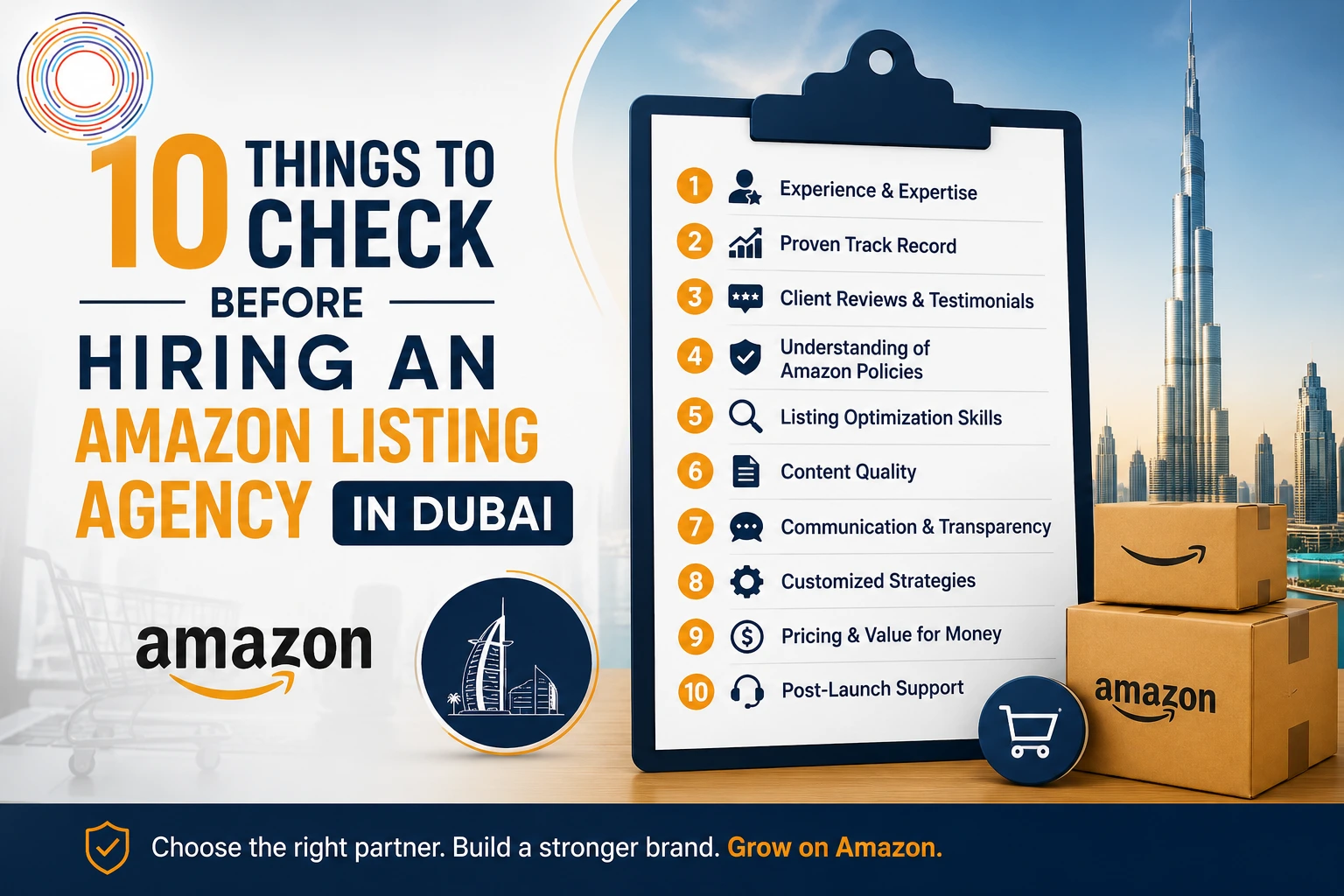
Because of this, many companies seek Amazon product listing Dubai services when listing products. However, using the wrong partner can create more issues than it solves. Therefore, there are many important factors that a seller should look at before selecting a dubai amazon listing agency.
Why Choosing the Right Amazon Listing Agency Matters
A Product Listing on Amazon isn’t just a description; it’s a combination of many different things–a sales page, search engine asset and conversion tool.
When listings are properly optimized, products will show up better in search results, connect better with customers, convert at higher rates, and allow for long-term marketplace growth. Conversely, poorly optimized listings can result in reduced discoverability, expose sellers to compliance risks, and diminish their advertising results.
An experienced agency will know how the Amazon algorithm ranks content with respect to relevance; how consumers make purchasing decisions; and how competition in the marketplace impacts the visibility of your products.
Working with the right partner can increase:
- Organic rank
- Advertising return on investment (ROI)
- Product discoverability
- Customer trust
- Marketing compliance
- Catalog performance
Working with the wrong agency may leave sellers with keyword-stuffed content, low conversion rates, and wasted advertising spend.
1. Check Whether They Understand Amazon SEO Beyond Keywords
The most common error made by sellers is to think all that is needed to rank on Amazon is to “add” keywords to their title. However, as professional Amazon listing specialists know, Amazon isn’t merely looking for the “presence” of keywords when they rank products. A number of other factors like search intent, category alignment, conversion performance, backend terms, and customer behavior all impact rankings.
Example: If a seller creates an extremely high-traffic title using all available keywords in their title, their title will likely be (Wireless Bluetooth Earbuds Headphones Earphones Noise Cancelling Sports Earbuds) an appropriate representation of each of those products; but will create a bad experience for customers because there is no flow in the title.
A better option for the seller would be to create an approachable title that maintains keyword relevance, gives customers a clear buying intent, and ultimately promotes a positive user experience.
A qualified agency should discuss:
- Keyword placement strategy
- Backend search term optimization
- Category-specific optimization
- Search intent alignment
- Relevance signals that affect rankings
If the agency’s explanation consists only of how to insert keywords/go beyond keyword placement, you should continue your search for an agency.
2. Review Actual Listing Samples and Case Studies
Agencies are always able to claim they have expertise; however, the more important question is whether or not they’re able to prove it through results. Are you also able to get examples of the listings they’ve optimized?
In addition to looking at aesthetic appeal, you should look at measurable results such as:
- Increased Conversion Rates
- Organic Ranking Improvements
- Increased Session Counts
- Higher Click-Through Rates
- Better Advertising Results
A comprehensive case study will show you the problem being solved, the changes that were made and what the result was.
When reviewing samples, consider these attributes:
- Title Quality
- Bullet Point Format
- Product Description
- Keywords Integration
- Visual Presentation
Remember that the goal isn’t to provide a bunch of fancy writing—the real goal is to provide improved buying decisions!
3. Evaluate Their Understanding of the UAE Marketplace
There are a number of agencies that say they provide Amazon UAE seller services, but they typically use a generic approach based on other markets. However, buying habits of consumers in Dubai differ from those of consumers in the US, UK or Europe.
To effectively help you sell on Amazon, an agency must know:
- local buying habits
- competition in the region
- when is the best time to sell based on seasonal trends in the UAE
- search behavior (in both Arabic and English)
- patterns of demand in each category
For example, search terms used by consumers in the UAE may be very different from those used in other countries, so even a product that is successful in other countries could need to be modified when it is offered as a listing on Amazon UAE.
The difference between agencies that are simply “ok,” and those that are highly effective at selling on Amazon is how much they know about the market.
4. Check Their Product Image Optimization Capabilities
Many sellers concentrate mainly on keywords and fail to give enough attention to product photos. However, a product image can often provide more influence on conversion rates than written descriptive copy. The main image of a product listing is what causes a customer to click through from the search results, and then additional images in the listing are what answer the questions customers might have about buying that item.
As an agency, you’ll want to understand the following:
- Requirements for main image compliance
- Principles of infographic design
- How to create lifestyle images
- How to visualize product features
- How to display images mainly on a mobile device
Take, for example, a listing for a kitchen appliance. One version could show just the appliance on a white background, while another version could show size comparisons, use cases, the benefits of the product, how it will fit in the customers’ lifestyle. In almost all cases, the second listing will convert significantly better because it reduces uncertainty as to what the product will do.
Visual content is an essential part of conversion optimization on Amazon.
5. Assess Their Product Title and Bullet Point Strategy
By creating informative titles and bullets, you are both providing information to customers, and allowing Amazon to see that your product is relevant.
Having the highest number of keywords visible to maximize your visibility has caused many companies to put readability on the back burner.
Therefore, you are likely to have content that is poorly ranked and/or poorly converted.
Optimizing for the following is critical:
- SEO Factors
- Readability for Customers
- How the Product is Different Than Other Products
- The Mobile Shopping Experience
Keep in mind that the majority of those who shop on Amazon are using mobile devices.
When a title loses clarity on a small screen, it often leads to less engagement.
In order to be aware of how an agency approaches title structure & bullet point structure as well as bullet point structures focused on benefits or the psychology of the consumer, be sure to ask them.
6. Ask How They Measure Listing Performance
Professional optimization should be founded on actual data. If you cannot explain how your agency measures success, there’s a red flag.
There are several key metrics:
- Click-through Rate (CTR)
- Conversion Rate
- Organic Ranking Positions
- Sessions
- Unit Session Percentage
- Advertising Efficiency
- Sales Velocity
Picture a listing getting traffic while its conversions are decreasing.
A credible agency would determine whether or not the customer experience created by search results is in line with the offer on the listing.
Without any performance measurements, optimization relies entirely on conjecture.
7. Verify Their Amazon Compliance Knowledge
The guidelines for Amazon change frequently.
Sellers can risk being noncompliant if the agency that is assisting them does not have any knowledge of compliance.
Some common compliance problem areas include:
- Restricted Claims
- Image Violations
- Regulation Issues by Product Category
- Trademark Issues
- Product Content issues
For example, health and wellness products often experience very strict content requirements.
If a product makes a claim that may be false, it may be suppressed from appearing in search results and/or the seller/account may receive a warning of noncompliance.
Therefore, it is important for any seller to utilize an agency with the knowledge of creating compelling content while remaining compliant to Amazon’s policies related to that content.
Developing and protecting the seller’s account health through the entire optimization process should be an essential function of the optimization process for any seller.
8. Understand Their Process for Competitor Analysis
Market intelligence forms the foundation for developing strong listings. Prior to content rewriting, agencies need to assess competing items in the product category.
Competitor research involves:
- Content benchmarking
- Keyword opportunities
- Feature assessment
- Pricing review
- Review researching
- Positioning research
For example, if many of a competitor’s items have received negative reviews related to lack of battery longevity, then a seller with a product that addresses that feature should promote this advantage across the entire listing.
Without conducting any competitor research, many opportunities for valuable differentiation are likely to be missed.
Conducting competitor research is critical to improving product ranking on Amazon.
9. Check Whether They Coordinate with Advertising Strategies
There should never be a separation between your advertising and listings. Many vendors will put a lot of money into PPC campaigns but their traffic is going to poor product pages.
This will lead to predictable results; increasing the cost of advertising but having less conversion.
A knowledgeable agency will know the relationship between:
- Amazon listing optimization
- Sponsored Products campaigns
- Sponsored Brands campaigns
- Improved conversion rates
- ROI for Advertising
As you improve the listing(s) for a product, you will also see improvements in the performance of your advertising because you will attract more customers from your traffic.
The connection between listing and advertising success is crucial for managing the Amazon Marketplace successfully.
10. Evaluate Communication and Reporting Standards
Without good communication, even great optimization can be very frustrating. You should clarify your expectations before you hire an agency:
- How often they will report to you
- How many revisions they will provide
- When they expect to complete the project
- The agreed-upon deliverables
- Who owns the account
What the channels of communication will be
You need to have a clear understanding of what work is being done and how that work is progressing over time. Transparency is often a good sign of professionalism in the long run. If an agency doesn’t provide regular reports or provides only vague updates, it can lead to confusion and frustration.
What a Good Amazon Listing Service in Dubai Typically Includes
Typically, professional listing services in Dubai have a structured optimization process, not just to rewrite product descriptions. Some of the standard deliverables include:
- Thorough Keyword Research
- Listing Audit
- Product Title Optimization
- Bullet Point Enhancements
- Product Description Improvement
- Keyword Optimization for Back-End Search Terms
- A+ Content Suggestions
- Image Optimization Guidance
- Ongoing Performance Tracking
Some providers also offer Amazon Catalog Management and other Marketplace Growth Initiatives.
The best agencies consider optimizing listings as an on-going schedule rather than a single task.
Final Thoughts
Choosing the right amazon listing agency in dubai can have a significant impact on long-term marketplace performance.
The best agencies do much more than insert keywords into product listings. They understand buyer psychology, marketplace competition, compliance requirements, conversion optimization, and advertising relationships.
When evaluating potential partners, focus on expertise, process quality, reporting standards, marketplace knowledge, and proven results rather than selecting the lowest-cost provider.
A thoughtful evaluation process can help ensure that your Amazon product listing Dubai investment contributes to stronger rankings, healthier conversions, better advertising performance, and sustainable Amazon seller account growth over time.
Frequently Asked Questions
What does an Amazon listing agency do?
An Amazon listing agency helps sellers optimize product listings through keyword research, content creation, image recommendations, SEO improvements, and conversion-focused enhancements designed to improve visibility and sales.
How much does Amazon listing optimization cost in Dubai?
Pricing varies based on catalog size, complexity, competition, and the scope of services provided. Some agencies charge per listing, while others offer ongoing marketplace management packages.
How long does Amazon listing optimization take?
Initial optimization can often be completed within a few days to several weeks depending on the number of products. Ranking and conversion improvements typically require additional time as Amazon collects performance data.
Can optimized listings improve PPC performance?
Yes. Better listings often improve conversion rates, which can increase advertising efficiency and reduce wasted ad spend. Strong listing quality and effective PPC campaigns usually work together.
What should I expect from an Amazon product listing Dubai service provider?
You should expect keyword research, listing audits, title optimization, bullet point improvements, backend search term optimization, image guidance, compliance awareness, performance tracking, and clear reporting throughout the engagement.
